Show Trivia
MIND BENDING FACTS
Biography and Personal Life
Time Periods
E=MC² explores three time periods in Albert Einstein’s life: 1) his university days, 2) the rise of Hitler, and 3) his later days in Princeton.
His Father
Albert Einstein’s father had an electrical firm that was instrumental in bringing electricity to Munich around 1885.
Narration From Einstein
Although E=MC² covers much of Einstein’s younger years, it is narrated by the ‘75-year old Einstein’ reflecting on his life from his study in Princeton.
Citizenship Details
Albert Einstein renounced his German citizenship and became a Swiss citizen in 1901. He kept his Swiss citizenship even after becoming an American citizen in 1940.
Einstein's Schooling
Albert Einstein was of German Jewish Ashkenazi descent, but he attended a Catholic elementary school up to 1888. Albert Einstein received his PhD from the University of Zürich in 1906.
Swiss Patent Office
Einstein worked in the Swiss Patent Office for years before he reached his goal of becoming a professor.
AE Height
Albert Einstein stood at around 5’7” and was of slight build. He also loved to sail – even though he couldn’t swim.
Bibo The Parrot
Albert Einstein received a pet parrot “Bibo” at age 75, about a year before he passed away after refusing surgery.
Relationships and Personality
Wisdom and Humor
Einstein’s wisdom was at times mixed with self-deprecating humor, which created many profound and eternal quotes. In E=MC², many of Einstein’s famous quotes actually set the scene from his own personal perspective, such as: “I have never lost a sense of distance, and a need for solitude” and “Live in that solitude which is painful in youth, but delicious in the years of maturity.”
His Sons
Albert Einstein never had a close relationship with his two sons because they lived with his wife after their separation in 1914.
Einstein's Sister
Einstein was very close to his sister Maja, who came to live with him in Princeton.
Mileva
Einstein’s first wife, Mileva, was the only woman at Zurich’s Polytechnic, and was the second woman to ever finish a full program of study in Mathematics and Physics. Einstein and his first wife, Mileva, enjoyed listening to music, and could even be considered a bit “bohemian” for their time.
Nobel Prize Winner
True to his word, after winning the Nobel Prize, Albert transferred the money to his first wife, Mileva, who is said to have helped Einstein in his early work. Though still debated, the play E=MC² takes the position that Mileva did contribute.
Second Wife Elsa
A common practice in the early 20th century, Einstein married his first cousin in 1919 shortly after divorcing his first wife. She fell in love with Albert when she heard him play the violin.
Love of Music
In addition to science and math, Einstein loved music. He played the violin, and loved Bach and Mozart, but he hated Wagner.
Favorite Philosopher
Einstein’s favorite philosopher was Emmanuel Kant, who was also famous for his quotes.
Scientific Impact and Legacy
Impact Today
Einstein’s theories of relativity have impacted many scientific systems of today, including satellite technology, GPS systems, and semiconductors.
Quantum Mechanics
Einstein worked on the foundations of quantum mechanics and was working on developing Unified Field Theory at the time of his death.
Olivia Newton-John
Einstein’s colleague Max Born was a Nobel Laureate and is credited as being instrumental in the development of quantum mechanics. His granddaughter is Olivia Newton-John.
Hebrew University
When Einstein died, he left his intellectual property to the Hebrew University of Jerusalem. The play E=MC² has personality rights of Albert Einstein with permission of this University.
Activism and World Events
Atomic Bomb
In 1939, Albert Einstein warned President Roosevelt that Germany might build an atomic bomb. Einstein’s mathematical formulas subsequently assisted the US Armed Services in developing ballistics and munitions. Later in life, Einstein had misgivings about his contributions to WWII. His regret is expressed in the E=MC² song “If I Only Knew.”
NAACP
Impassioned by themes of social justice, Albert Einstein was a member of the NAACP, which works to secure civil rights, combat racial discrimination, and promote equality for Black Americans.
Paul LeRoy Robeson
Einstein’s lifetime friend Paul LeRoy Robeson was the third African American to attend Rutgers University. An activist and star NFL athlete, he also received a Grammy and star on the Hollywood Walk of Fame.
Musical Timeline
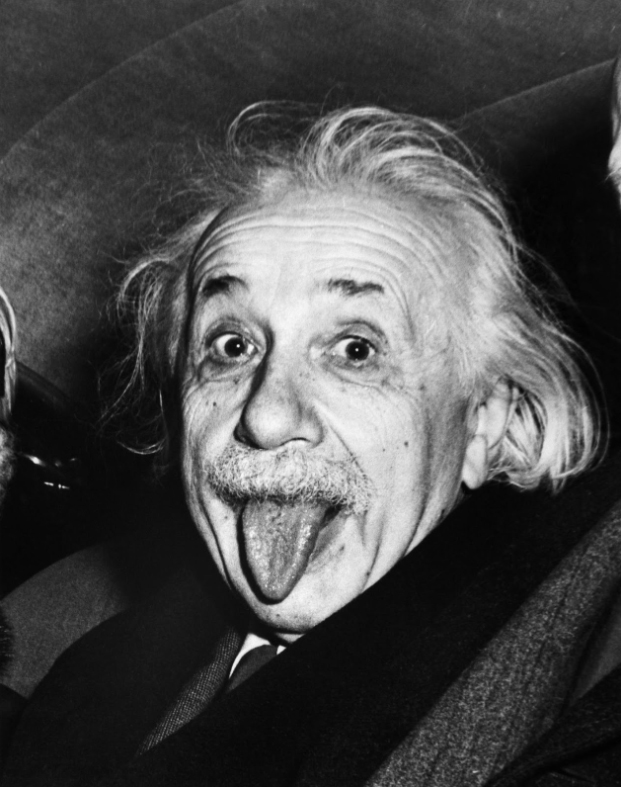
Scene to Watch For
Among other entertaining scenes, the show includes a scene where Albert Einstein amusingly recreates this famous photo.
Music Samples